Requirements & effects
Needs (a cost)
Nothing in the Ledger is free. This is the rule that says what an action costs, or what a player must be holding before it will run.
What it is
Needs is a requirement, and often a cost. You name a component and an amount. When a player starts the action, the game looks for that amount in the player's bag or in the place. If it is there, the action goes ahead. If it is not, the action is refused. You choose whether the amount is used up or only has to be held.
Example
Needs 3 Wheat Sheaf, used up. Needs 1 Brass Key, kept.
Which actions use it
Buy (the price), Craft (the ingredients), Build and Upgrade (the cost), Make things (what it needs), Open, Play story, Learn, Research and Complete (the turn-in). A Travel takes costs through the Exit dialog. Sell, Handle event and the combat moves take none.
- Craft: the ingredients of a recipe.
- Build: what a new Structure costs.
- Upgrade: what the next tier costs.
- Research: what a topic costs to study.
- Travel: what an Exit asks of the player.
Settings
| Setting | What it means | Example |
|---|---|---|
| Component | What is asked for. Required. | Wheat Sheaf |
| Level | Which level of the component, when it has more than one. | Level 1 |
| Comparison | How the player's amount must stand against yours: at least, at most, exactly, fewer than, more than. It starts at "at least". | at least |
| Quantity | The amount. | 3 |
| Where | "from the player's bag" or "from this place". | from the player's bag |
| Used up | Ticked: the amount is taken. Not ticked: the player only has to hold it. | ticked |
Open the action in the property window. Each cost is a row with Choose a component, Quantity, Where and Used up. The Needs column holds the comparison. ADD at the right of the section adds a row. A row reads back as a sentence, such as "Costs 3 Wood from this place" or "Needs at least 1 Brass Key (kept)".
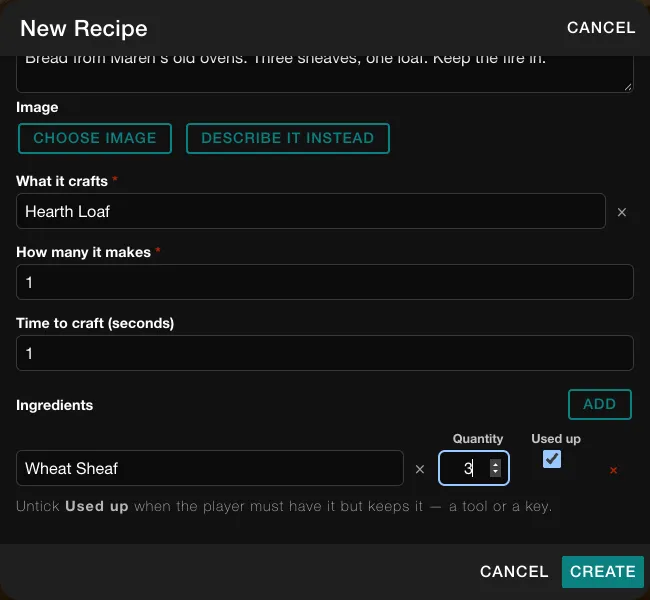
When you create a Recipe, the dialog has an Ingredients list with the same rows. Click ADD, pick a component and set Quantity.
In Vespera
In Vespera: bread, and a mended forge Play it
- Used up. Step 3's Recipe: Hearth Loaf needs at least 3 Wheat Sheaf from the player's bag, and they are used up. The loaf is crafted in 1 second.
- Kept. The research Mend the Old Forge is studied with a Study action that takes 15 Vesper Marks and 6 Iron Nails, both used up, and asks the player to hold 2 Ledger Pages. The pages are kept. The player studies the topic with the pages still in the bag.
Good to know
- Kept or used up? Tick Used up for money and ingredients. Leave it off for a key, a pass or anything the player should still own afterwards.
- A word that cannot be used up. With "at most" or "fewer than", the Used up box is off and cannot be ticked. The editor says "Never used up: this only checks what the player has."
- Asking for none. An amount of 0 is accepted for "at most", "exactly" and "more than". "Fewer than 0" is refused, because it can never be met. See Comparisons.
- A cost that never blocks is a different rule: Also takes, if there is any.
Under the hood
- Every cost on an action is checked first. Only when all of them pass is anything taken. A player who is short on one cost loses nothing.
- A cost that is kept is met by the named level and by any higher level of the same component. A cost that is used up is met only by the exact level.
- A cost never rolls a chance and never takes a random amount. The editor hides both and resets them on save.
- On Make things the cost is taken once for each run, so a stack that runs several times takes several times as much.
- A cost with an amount of 0 and the default word, at least, is a free cost and always passes. It is never a gate.
- A cost that the editor cannot complete (a free cost, a negative amount, a place the editor does not offer) is not changed by a save. It shows as a read-only line.
- The game never takes anything on a sale, so Sell has no cost.
- When you ask the assistant for a cost, say that it is used up. A cost that does not say so is kept.