Ideas & systems
Paths and travel
A map shows where places are. It is the paths that let a Maker's players walk between them.
What it is
Travel is how a player gets from one place to another. You build it with paths. A path is a signpost standing in a scene, with a destination built into it. The destination is a place on the world map.
You do not draw lines between pins on the map. A world is a web of places, and the signposts are its threads.
How it works
- A path stands in a scene. It has a Travel action, and the action holds the destination.
- The player taps the signpost and chooses Travel. The game checks any rule the path carries.
- If a rule is not met, nothing moves. The player sees an alert and stays where they are.
- If the path is free, or the rules are met, the player arrives. The new place loads. Its arrival actions run, and any enemies there wake.
- The way back is a path of its own. A path goes one way. The other place needs its own signpost.
A path can ask for things first: an item, a story the player has seen, a stat, or a research they have completed. A research is kept, not used up, so the player passes every time afterwards.
In Vespera
In Vespera: the hub, the spokes and the Mine Play it
Vespera has ten paths. The Last Outpost is a hub with four spokes. The four places at the ends of the spokes each have a path home. The Hollow Road has one more path, down to the Gloam Mine, and the Mine has a path back up.
| Place | Paths out |
|---|---|
| The Last Outpost | Path to the Withered Fields, Path to the Silent Forge, Path to the Hollow Road, Path to the Bards' Ruin |
| The Withered Fields, The Silent Forge, The Hollow Road, The Bards' Ruin | "Back to the Last Outpost" from each one (four paths) |
| The Hollow Road | Down into the Gloam Mine |
| The Gloam Mine | Back up to the Road |
Two of the ten have a gate. Path to the Hollow Road needs the story The Smiths Return, at least 1. Down into the Gloam Mine needs the research Wayfinder's Lore: 1, kept, read from the player's bag. A research is never used up, so a player who has it can go down and come back as often as they like.
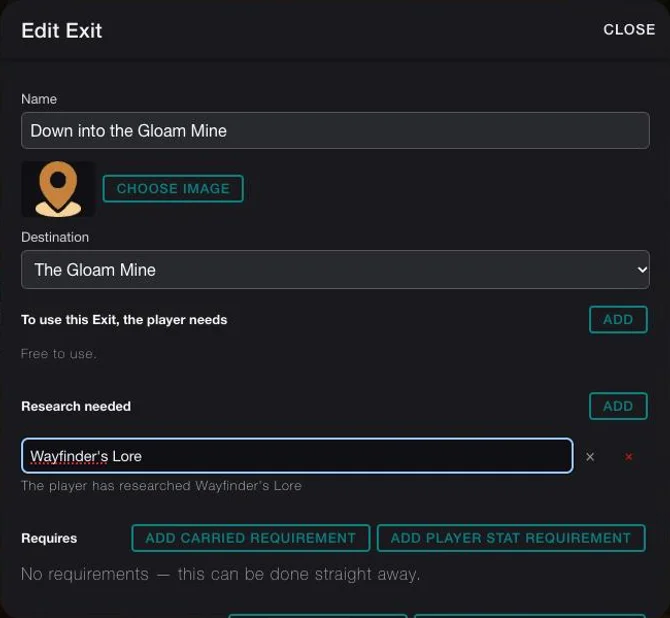
In play, a player who had not done the research tapped the signpost and chose Travel. An alert read "Requirements Not Met / You do not have the required resources to do this. / 1 Wayfinder's Lore". They stayed on the Hollow Road.
The player earned Wayfinder's Lore from the Research tab of the journal. It took about twenty seconds and cost 20 Vesper Marks and 2 Timber, and the player needed at least 4 Ledger Pages (not used up). With it, the same tap on the signpost and Travel loaded the Gloam Mine. Tapping the signpost "Back up to the Road" there, then Travel, took the player home to the Road.
Good to know
- Free means no gate. Do not add a rule to a path that should be free. The way back from a place carries no gate in Vespera.
- Test gates in play. Edit Mode travel skips the rules. In Edit Mode the Down path worked without the research.
- Remove the signpost and the path goes. A path and its placement are one. See Path.
Under the hood
- A path is made together with exactly one placement in a scene, and the two live and die together. A path cannot be moved to another place. Make a new one there instead.
- The older way to link places was to draw connections between map nodes. The builder still shows that for old games, but it is not the way to author travel. A map with no connections lets players travel between its places.
- Even a signpost's built-in destination is checked by the game before the move happens.
- Edit Mode can travel through a path to check where it leads. That move skips the path's cost and rules.
- On arrival the game runs the new place's Open and story actions if their rules pass, and a rule that fails only skips that action. The travel still succeeds.