Reference
World map
Every Ledger needs a chart, or the roads are only rumours. The world map is the chart, and each place you make is pinned to it.
What it is
The world map is a picture with pins on it. Each pin is a map node, and each node holds one location, a place with a scene. The map is where those places are laid out, and it is the map a player can open in play to see where they are.
A game has at least one map. The map has a name, an optional description, its picture, and a style for how its pins are drawn.
Settings
| Setting | What it means | Example |
|---|---|---|
| Name | What the map is called. The edit page carries it in its title. | Vespera |
| Description | A short note about the map. Optional. | None set |
| Map picture | The picture the nodes sit on. | A painted overworld |
| Nodes | The pins, one per place you can reach from the map. | Six |
| Map style | How nodes, their labels and their links are coloured and sized. | Parchment colours |
Setting it up
- Open the Edit Map page for your map in the world admin. Its title carries the map's name, for example "Edit Map 'Vespera'".
- Drag a node's marker to move it. A node saves where you drop it.
- To change colours and sizes, open the collapsible Edit Map Styles panel. See Map style.
A new place made with the New place choice of the Add Exit dialog in Edit Mode is put on the current map for you. See Make a new location with scene art.
In Vespera
In Vespera: the Vespera map Play it
Vespera has one main map, called Vespera, with six nodes: The Last Outpost, The Withered Fields, The Silent Forge, The Hollow Road, The Bards' Ruin and The Gloam Mine. The first five were there from the start. The Gloam Mine was added last, as the new place at the end of the Hollow Road.
The map picture is a painted illustration of green land, a river and mountains, with a castle town at its centre. It is not parchment. The Map style colours the pins and their labels only.
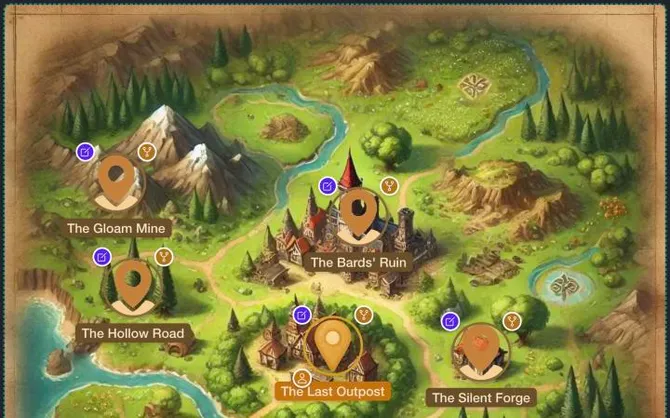
In play, a player taps the Map stone on the Hollow Road and the map opens in a window titled "Currently At The Hollow Road". It shows the painted map, six pins, a marker at the player's current place and a caption made from that place's node: "The Hollow Road / The overgrown road out of the outpost, where travellers meet trouble." The Map stone asks for the research Wayfinder's Lore first. Without it the player sees "Requirements Not Met / You do not have the required resources to do this. / 1 Wayfinder's Lore".
Good to know
- A map is not a scene. The map is the zoomed-out board. Each place's own picture is its scene background. See Location.
- Pins are markers. A node does not hold the place's contents. The place it shows does. See Map node.
- Links are paths now. Players travel by tapping signposts in scenes, not by lines drawn between pins. See Paths and travel.
Under the hood
- A game can hold more than one map. Vespera has one main map, and a second, hidden map is used only to compose pictures for these docs.
- A map can name a parent map, so that one map sits inside another. The builder does not offer this, and the game uses it only in part.
- Switches for a public map, fog of war and drawing connections are in the data, but the builder does not show them yet.
- A map's node style is saved with the map as one block of settings and read back when the map opens.