TL;DR
- MultiBit is open to everyone. It's free, it runs in your browser, and the games play on phones and desktops. No waitlist, no download.
- It's an engine for games about choices, not reflexes: story, simulation and exploration.
- Your game is yours. Export it any time as one file in an open format.
- I'm much better at building engines than designing games. If you have a game idea, I'd like to help you build it.
I set out to make one game
Over two years ago I started building a startup business simulator. I wanted to turn everything I'd learned trying to get a startup off the ground into something you could play: customer research and interviews, product development and testing, then the go-to-market grind of social posts, paid ads and website work.
It started as a dedicated HTML and JavaScript game. As the scope grew I kept reworking it, and at some point I realised the parts I was reworking weren't really about startups. They were about resources, actions, time, places and stories. So I pulled them out into a reusable engine.
I never made it back to the startup game. Somewhere along the way I got jaded with the startup idea and lost my passion for it. The engine, though, I never lost interest in.
Then I kept building the engine
Here's my confession: I love building systems, interfaces and tools. Every time I sat down to design a game, I came back up having built a better way to build games.
The biggest side quest was travel. First you could create a location and travel to it. Then I decided a location should be a template, and that the world is made of instances of those templates, so a "Forest" can appear in ten places, each with its own loot and its own story. Then I had a map to travel on, and decided players would rather walk through a door or follow a path in the scene itself, so I built in-scene navigation too. Each of those was the right call for the engine. None of them got a game finished.
I've written before about solo dev, scope creep and overwhelm. This post is the other half of that story: I've stopped fighting it. I'm the engineer. What MultiBit needs now is designers, artists and storytellers.
What MultiBit is for
As I've got older, the games I love have moved from shooting, to simulation, to exploring, to story. MultiBit is built for that kind of game:
- Story. A lot of story can be told with still images, sound and words. I've seen wonderful motion comics made from nothing more than pictures that slide, zoom and fade. MultiBit's timeline editor does exactly that, with music and voice-over.
- Simulation. Simulation is about decisions with trade-offs: where to spend scarce resources, which path to grow along, what to give up.
- Exploration. Exploration is about deciding where to go next. You don't need to steer a character through an open world to feel mystery, surprise or awe.
The game I hold up as the gold standard is Master of Orion: explore the galaxy, settle planets, manage an economy, research your way up a tech tree, and deal with whoever you meet out there. MultiBit already has most of what you'd need to build a game like that.
What it isn't for: shooters, platformers, racing, physics, or anything that tests your reflexes. To see what it can do, play Escape From Berlin, a narrative escape from Cold War East Berlin (here's how it was built).
Your first ten minutes
It depends what kind of game you have in mind:
- Exploring? Add a couple of new places to travel to. Give each one a mood with environmental effects and music, scatter some resources to gather, and let the player spend what they gather building up a home base.
- Simulating? Build a structure that turns one thing into another, say wood into planks. Add a second that needs planks. Now you have a resource loop, and the player has decisions to make.
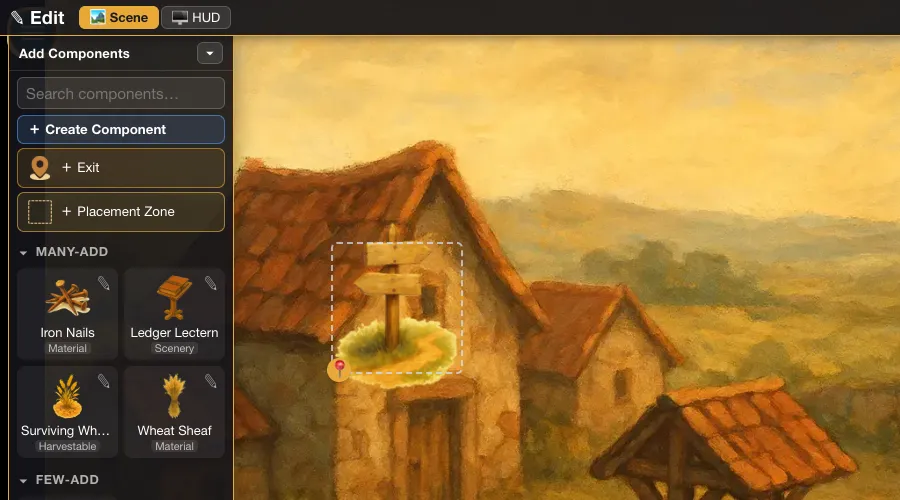
You do all of this inside the game while you play it, by hand, or by asking the built-in assistant to do it for you. Your first quest in the docs walks you through it.
Where AI fits, and where it doesn't
The core engine was hand coded, the good old-fashioned way, one keystroke (or copy and paste) at a time.
I've leaned on AI heavily since then, and I'd rather be upfront about where. It helped me build the agent and MCP layer, a large part of the in-game editor, and a lot of the testing and bug fixing.
That agent layer is the part I'm proudest of. Think of it as a help system with superpowers: ask it what the engine can do and how, or ask it to make a change to your game, and nothing changes until you approve it. You can use it in the game, or connect your own AI, such as Claude or ChatGPT, over MCP. I wrote more about it in Skip the docs, ask the agent.
MultiBit can also generate placeholder art, using the most lightweight image model I could find. It's a lot easier to see your idea come together when it looks like itself, even roughly. Every account comes with plenty of credits to try it.
I know a lot of people hate AI in games, and I understand why. I'm taking an agnostic approach. You can build a MultiBit game without touching any of it, and your game will probably look more consistent and more personal for it. But I also want anyone with an idea to be able to build it and share it as easily as possible. Use it, or don't.
Your game is yours
Building on a small, new engine is a fair thing to worry about, so here's how MultiBit tries to deserve your time:
- Open format. Every game can be exported as a single file, art and audio included, in a published, open specification. Import it back whenever you like.
- An open-source player is in progress, aimed at games that run from any web host, with no MultiBit server needed.
- It isn't going anywhere. Hosting MultiBit costs me very little, so it can stay up more or less indefinitely. And if I ever do close the doors, I'll open-source all of the code so people can host it themselves.
A line in the sand
There's so much more MultiBit could do: embedded video, sprite animation, payment rails, building together with collaborators. Left alone, I'd happily build all of it. Instead I'm drawing a line in the sand and waiting to hear what people actually need.
Whatever gets asked for most comes first. If I had to bet, it'd be payments, because giving creators a way to earn from what they make matters more than any feature I could add for fun.
So here's my offer
If you have an idea you'd love to see as a game, bring it to me. You bring the design, the art, the story. I'll be the engineering side:
- I'll answer your questions.
- I'll help you work out how your idea fits the engine, and brainstorm the parts that don't yet.
- Where the engine falls short of what your game needs, I'll change the engine, within reason.
I'll do most of this in the open on Discord, so everyone else can see it and learn from it too. I'm open to almost any idea, but exploration and RPG ideas get me the most excited.
What I'm asking in return is your honest feedback, even when it's harsh. And if you end up with something you're proud of, I'd love to show your game off and hear what you thought of making it.
What success looks like
Not a number of sign-ups. Success is a stranger, someone I've never met, building ten minutes of gameplay that's genuinely compelling. If that's you, let's build it.
The Discord invite comes in your welcome email when you make an account (that keeps the spam bots out). Or send me a message and tell me about your idea.