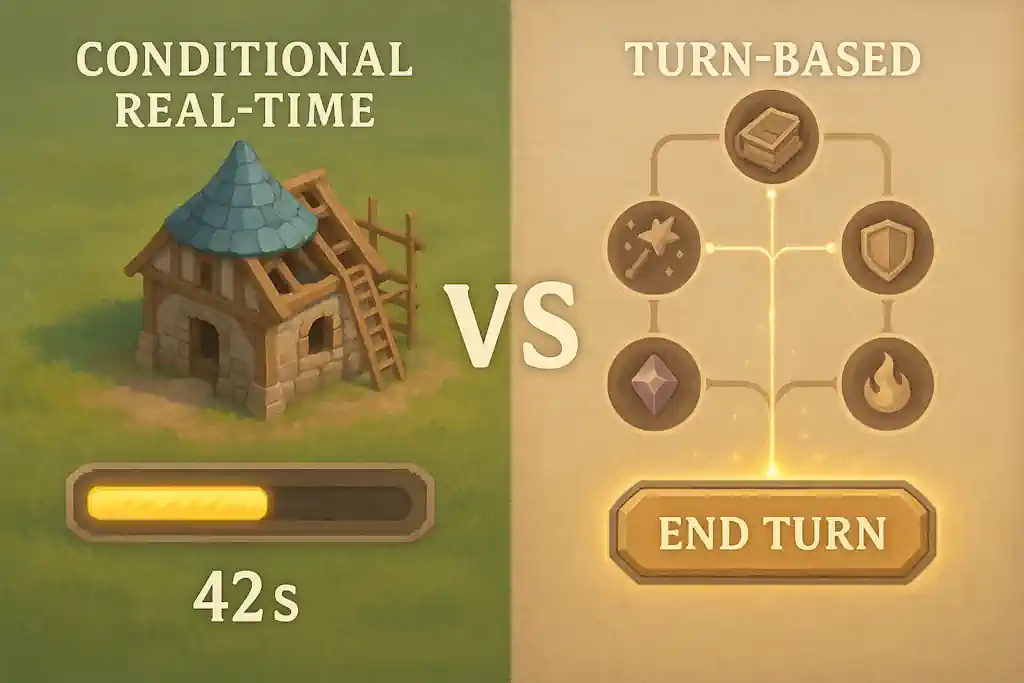
TL;DR: How Games Handle Time
- Real-time: The world moves on its own. Default for action games. Creates tension and check-ins, risk is contrived waiting.
- Conditional Real-time: Things take a real amount of time to complete, but nothing happens that the player doesn't trigger.
- Turn-based: Time only advances when the player acts. Encourages strategy and thoughtful decisions.
- Many mobile games use conditional real-time, but often to create artificial delays just to drive monetization.
- Strategy and narrative games tend to use turn based, giving players ample time to immerse themselves and ponder their choices.
- The time mechanic chosen shapes pacing, emotion, agency, and how your players experience your game.
Every game makes you wait for something. The question is: are you waiting on yourself to consider strategies, because you are navigating the world, or are you waiting simply because the designer wanted you to?
When you build a game, you're not just designing what players do, you're designing how and when they do it.
Time progression is often taken as self-evident in game design, and for many games, especially arcade and action games, there's really only one choice: real time. But if you're designing a game with more depth than a platformer or shooter, you have other options.
Which you choose shapes emotion, pacing, and strategy. It governs the player's relationship with your game: whether they can act freely, have to wait, or need to think hard before every move. It's central to how you want your players to experience your game.
The vast majority of PC and console games are real time, and depend on movement and reactions. But I'm exploring this topic in the context of casual, idle, simulation and resource management games, which tend to be more self paced.
Conditional Real-Time: More Dopamine, and Frustration
Conditional real-time games almost always have something going on, or at least, they need to. Otherwise, it gets boring.
This model is designed for anticipation. There is something visceral and rewarding about progress bars ticking towards completion. They keep you in the game just a little bit longer, for just one more action or upgrade. Wait for the wheat to finish growing, then you can kick off feed production. Oh heck, what's another 20 seconds? Then I can feed my chickens!
But here's the rub: after you've kicked off all your upgrades and production jobs, and no more actions are available, what do you do?
Unless your game is finely tuned, the answer is usually: wait.
For mobile games, this is usually intentional. They want you either come back every day or even multiple times a day to continue playing. This helps habituate the game and optimize player retention.
In the beginning, the waits are short and it feels like there is lots to do. But as you level up, tasks take longer and longer to complete, and players find themselves frustrated, waiting more than playing.
But now they're hooked, and this frustration is designed intentionally. It's contrived pain point introduced solely for the purpose of driving in app purchases to skip the wait and keep the game moving along.
Let that sink in.
The time mechanic is engineered to disempower players, just enough to create a pain point they'll want to pay to remove.

But that doesn't mean conditional real-time is inherently exploitative. Like any tool, it depends on the intent behind it, and how the rest of the game supports the player experience.
Used thoughtfully, conditional real-time can evoke a sense of rhythm and anticipation that enhances immersion. For example, if downtime is used to encourage players to reflect, plan, or engage with other layers of the game, like reading lore, adjusting their strategy, or decorating their space, the wait becomes a pacing mechanic, not a paywall. The key difference? The player still feels in control.
Another approach is to make wait timers narratively meaningful. Imagine a game where your blacksmith isn't just filling a progress bar, he's writing letters home between projects. The timer still runs, but what you unlock isn't just output, it's context. Players stay engaged, not because they're desperate to skip the timer, but because they're curious what comes next.
Conditional real-time can create a satisfying cadence, if the game offers parallel paths of engagement, rewards patience instead of punishing it, and never treats time as something to be sold back to the player.
Turn-Based: Thoughtful, Empowering, but Slower
Turn-based systems flip the script. Here, time doesn't move until the player says so.
For examples of high profile turn based games, look at Civilization, XCOM and Masters of Orion (oldie but a goodie). And while not a video game, Dungeons and Dragons is a turn based table top game that has stood the test of time.
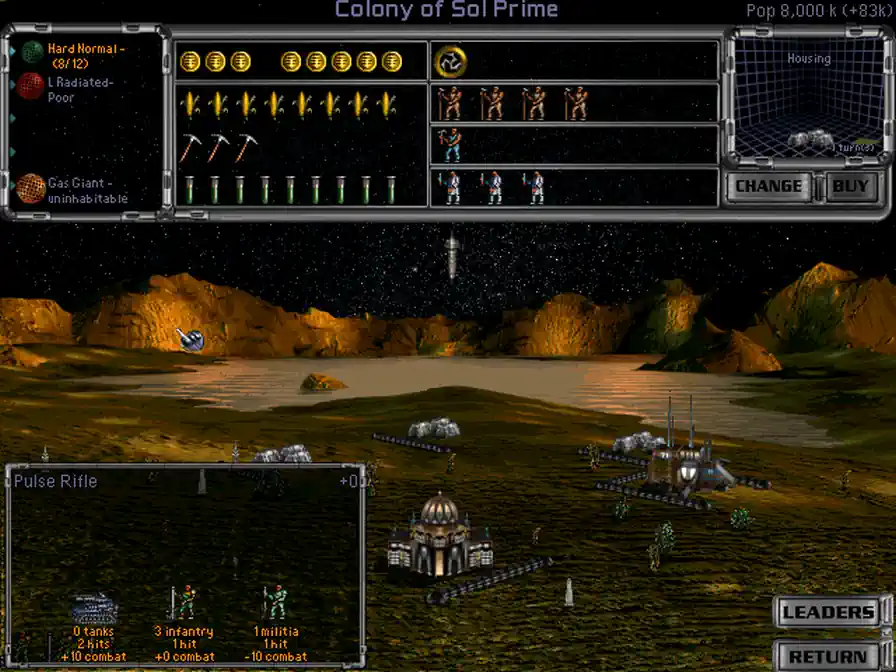
That gives the player power. They can explore, optimize, plan. They can think through a problem rather than react to it. The stress of missing out is replaced by the satisfaction of mastering a system.
It's not as flashy. You won't see countdowns or collect five different currencies every 90 seconds. But you will get players who feel in control. Who can take a break and come back without penalty. Who feel like their choices matter.
For the simulation game I'm building, this was a turning point.
I started in the conditional real-time camp, after all, that's what most successful mobile games use. But the more I thought about the kind of experience I wanted to offer, the more I saw the value in turn-based structure.
So now, I'm supporting both in my platform, because they each bring something different to the table.
How I'm Using Turn-Based
One of the first systems I'm building in my Kickstarter Sim is about audience-building.
Players can choose from tasks like:
- Posting on social media
- Writing an article
- Filming a video
Each task consumes energy. Once they're out, they end their turn. It's not just a productivity simulator, it feels like real life. You can grind, but you'll burn out.
They also have the option of outsourcing some tasks. Maybe they're not technical, so instead of struggling to build a landing page, they hire someone. It costs money and takes 2-3 turns to deliver, but it frees them up to spend their energy on other tasks.
Now time becomes strategic. Do it yourself and lose momentum? Or spend resources to move faster?
On the other hand, doing something yourself lets you develop the skill, and get more proficient as you move forward.
These are the kinds of decisions I want players to wrestle with. They mirror the real-world tradeoffs creators face. In this system, time isn't just a limiter, it's a lens for thinking about growth, delegation, and the many valid paths to success.
How to Choose the Right Time Model for Your Game
If you're designing a simulation or interactive experience, the time model you choose will shape how players engage with your world. Here's a quick guide to help you decide:
Choose Conditional Real-Time if:
- Your game benefits from tension, urgency, or background progression.
- You want to reward frequent check-ins, like a farming sim or idle game.
- You're modeling activities that "run in the background," like factories, marketing campaigns, or crops.
Choose Turn-Based if:
- Your game emphasizes planning, decision-making, or storytelling.
- You want players to feel in control of the pacing.
- You're modeling complex tradeoffs, like managing energy, time, or strategic sequencing.
There's no right answer, just alignment between your system and your desired experience.
The Time Model Shapes the Game
Whether you're designing an RPG, a factory sim, or a storytelling experience, your time progression model is one of your most important decisions.
- Conditional Real-Time gives more anticipation and dopamine hits, thus can feel more engaging. It may also feel more familiar, especially for mobile gamers.
- Turn-Based empowers players and allows for deeper, deliberate pacing, but may feel slow.
Each one tells a different story about how the world works, and how much control the player has within it.
For my first game, I'm going with turn-based, as I want decisions to feel more deliberate. And I'm complementing that with an energy/stamina mechanic to allow players to perform various actions each turn, to increase the pacing a bit.
Want to Build One Yourself?
I'm building this platform so that you can make the kinds of games discussed without touching code. Not even visual scripting.
If you're a creator, coach, or storyteller looking for a more powerful way to connect with your audience, or you just want to build a game without writing code, head to multibit.games to sign up for early access.
Because your next story doesn't have to be told.
It can be played!